
Varsha Bullion & Elemental Analab.
India’s first public testing laboratory to introduce non-destructive elemental analysis by EDXRF. Since 1994, we have tested precious metals, industrial metals, powders, liquids, minerals, ceramics, and chemicals for jewellers, refiners, manufacturers, exporters, and researchers across the country.
Established
India's first non-destructive public testing lab.
Elements detected
Na (Z=11) through U (Z=92), one reading.
Standard turnaround
Same-day report for routine samples.
Sample consumed
Nothing dissolved, nothing lost, returned intact.
The detection window
Sodium to Uranium. One reading.
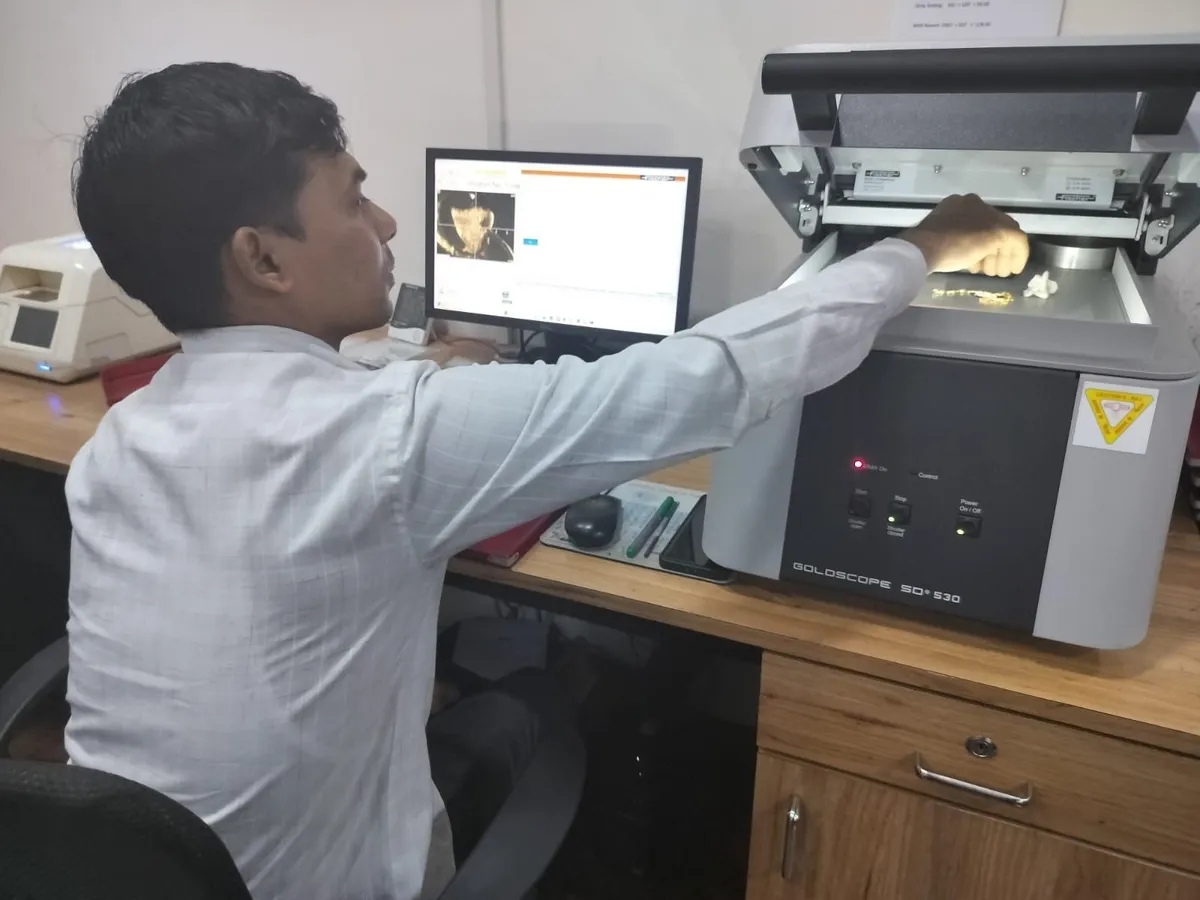
Our high-end Energy Dispersive X-Ray Fluorescence spectrometer reads every element from atomic number 11 to 92, both qualitatively and quantitatively, from a single exposure.
You do not have to tell us what to look for. The spectrum reports what is actually in the sample, including the impurities nobody expected.
The technique
Non-destructive, quantitative, repeatable.
The sample is not consumed, not dissolved, not altered. When you ask for it back, you get back exactly what you handed over, in the same physical state.
X-ray excitation
A focused beam of primary X-rays is directed at the sample. The energy displaces inner-shell electrons in the atoms it strikes.
Secondary fluorescence
As the atoms settle, each element emits secondary X-rays at an energy unique to that element. Gold, silver, copper, zinc, lead: every one has its own signature.
Energy-dispersive detection
The detector sorts the incoming fluorescence by energy rather than by wavelength. That is what allows the full elemental range to be captured in a single reading.
Quantification & reporting
Peak intensities are matched against calibration standards to convert the spectrum into percentages, reported per element, per oxide, or per compound.
Qualitative and quantitative
Not just which elements are present, but how much of each, reported as a percentage.
Sample returned intact
No cutting, no drilling, no dissolution. The material leaves as it arrived.
Same-day report
Standard turnaround is the same working day the sample is received.
Nominal charges
A flat per-sample fee. Written explanation of the result on request, at no extra cost.
What we test
Precious metals to industrial powders.
Solids, powders, liquids. If it fits under the beam and its elements sit in the EDXRF range, we can analyse it.
Precious Metals
SolidGold, silver, platinum, palladium: ornaments, bullion bars, doré, findings, scrap. Purity reported to four decimal places, with the full impurity profile alongside it.
Industrial Metals & Alloys
SolidFerrous and non-ferrous alloys, brazing rods, solders, electroplated coatings, welding consumables. Full elemental breakdown for incoming-goods and QC checks.
Chemicals & Compounds
Powder / LiquidInorganic salts, catalysts, pigments, plating chemicals. Reports issued in elemental form, oxide form, or as a specific compound (e.g. ZnCO3 plus impurities) where the chemistry is known.
Minerals & Ores
PowderOre-grade analysis, tailings, refined concentrates, and geological samples for prospecting, trading, and quality control.
Ceramics & Refractories
Powder / SolidClays, glazes, refractory bricks, tiles, glass batches. Oxide-form reporting as standard, matching how the industry specifies its raw materials.
Powders & Liquids
LiquidSlurries, solutions, plating baths, effluents. 5–10 g of powder or 1 ml of liquid is enough for a complete reading.
Sample requirements
Send us what you have.
Small quantities are enough. We do not consume material in testing, and returned samples are handed back in the same physical state you sent them.
Find the Zaveri Bazaar labPowder
5 – 10 grams. Any inorganic powder, catalyst, ore concentrate, or pigment. Dry and free of packaging contamination if possible.
Liquid
1 ml. Solutions, plating baths, effluents, slurries. Sealed containers preferred for volatile or corrosive samples.
Solid / Metal
Any small piece. Ornaments, bullion, wire, sheet, castings, findings. A clean, flat surface gives the most reliable reading.
Turnaround
Same day of receipt for standard samples. The report carries elemental percentages, oxide form where applicable, and a written explanation on request.
Charges
Nominal per-sample fee, quoted before testing. No separate charge for the explanation or for returning the sample.
The report
A number you can act on.
Every report is issued against a logged sample reference. Ask us what a figure means and you get a written explanation, not a shrug.
Elemental percentages
Each detected element listed with its measured percentage, main constituents first, trace elements below.
Oxide-form reporting
For ceramics, glass, refractories, and minerals, results are converted to the oxide convention the industry specifies against.
Compound-form reporting
Where the chemistry is known (e.g. ZnCO3), the report gives the compound percentage with the impurities alongside.
Impurity profile
The elements you did not ask about but need to know: lead, cadmium, and other unwanted metals in the alloy or batch.
Sample reference & date
Every sample is logged with a reference number and date of receipt, so a report can be traced back years later.
Written explanation
On request, a plain-language note on what the result means for your material, from the analyst who ran it.
Honest limits
What the technique cannot see.
A laboratory that only tells you what it is good at is not much of a laboratory. These are the boundaries of EDXRF, and we state them before you send the sample, not after.
Light elements below sodium
Carbon, hydrogen, oxygen, and nitrogen sit below the detection window. Organic content is not quantified.
Free moisture & water of crystallization
Water present in or on the sample is invisible to the technique. Dry the sample first if moisture affects your specification.
Volatile and organic constituents
Solvents, binders, oils, and organic additives are not reported. For those, a complementary technique is required.
Surface versus bulk
The reading reflects the excited volume near the surface. For plated, coated, or inhomogeneous material, tell us so the sample can be prepared correctly.
Who sends us samples
Thirty years of walk-ins.
The founder
Basantraj H. Mehta.
A chemist who built his own instruments’ worth of process knowledge first, and a laboratory around it second.
1972
M.Sc. Chemistry
Graduates in chemistry and begins working in speciality chemical manufacturing.
1973
Moves to Mumbai
Settles in Mumbai and starts manufacturing and exporting speciality chemicals using techniques he developed himself.
1994
India's first non-destructive public testing lab
Introduces high-end EDXRF as a public testing service, the first of its kind in India. Instant, authentic reports at nominal charges earn immediate acceptance in the trade.
Later
Varsha Bullion Hallmarking Centre
Founds a senior BIS-recognised assaying and hallmarking centre for gold and silver, among the earliest ten established in India, out of more than 1,600 today.
Ongoing
Trade & community leadership
Has held the highest positions in the trade's all-India and regional associations, as well as in major social and religious organisations.
Direct contact
Owner
Basantraj H. Mehta
M.Sc. Chemistry (1972)
Phone
+91 98210 52882Address
2nd Floor, Room No. 9/10, M H Dharamkant Building, Mumba Devi Road, Zaveri Bazaar, Mumbai, 400002, Maharashtra, India
Hours
Monday – Saturday: 10:00 AM – 6:00 PM | Sunday: Closed
Questions
Before you send a sample.
Still unsure whether your material suits the technique? Call the lab and describe it. We will tell you honestly if EDXRF is the wrong tool for the job.
Energy Dispersive X-Ray Fluorescence (EDXRF) is a non-destructive instrumental technique that identifies and quantifies elements from atomic number 11 (Sodium) to 92 (Uranium). The sample is irradiated with X-rays, and the secondary fluorescent X-rays it emits reveal its exact elemental composition, without altering or consuming the sample.
5–10 grams of powder, 1 ml of liquid, or a small piece of solid or metal. Nothing is consumed in testing. The sample can be returned intact if required.
Precious metals (gold, silver, platinum), industrial metals and alloys, chemicals, minerals, ores, ceramics, pigments, powders, and liquids. Reports can be issued in elemental form, oxide form, or as a specific compound where the chemistry is known.
Reports are normally issued on the same day the sample is received.
EDXRF does not detect free moisture, water of crystallization, or light volatile/organic constituents (C, H, O, N). For inorganic materials with a known compound structure (e.g. ZnCO3), the instrument reports the compound percentage alongside impurities.
The BIS-authorized hallmarking centre tests and hallmarks gold and silver jewellery under BIS regulation, issuing a HUID. Elemental Analab is a general-purpose analytical laboratory: it analyses any material within the EDXRF range and issues a test report. Both operate from the same Zaveri Bazaar premises under the same ownership.
Walk-ins are accepted during working hours, Monday to Saturday, 10:00 AM to 6:00 PM. For unusual materials, large batches, or a specific reporting format, call ahead on +91 98210 52882 so the method can be set up before you arrive.
Elsewhere at Varsha Bullion
Technology & process
XRF spectrometry, fire assay, and the calibration protocol behind every hallmark.
Hallmarking services
BIS-mandated hallmarking and HUID assignment for gold and silver articles.
Verify a certificate
Look up a VBHC hallmark certificate by its reference number.
Zaveri Bazaar centre
Directions, working hours, and contact details for the lab premises.
One sample. One day. One report.
Walk in, courier, or call ahead. Elemental Analab is at the Zaveri Bazaar centre in Mumbai and typically returns your report the same day.